
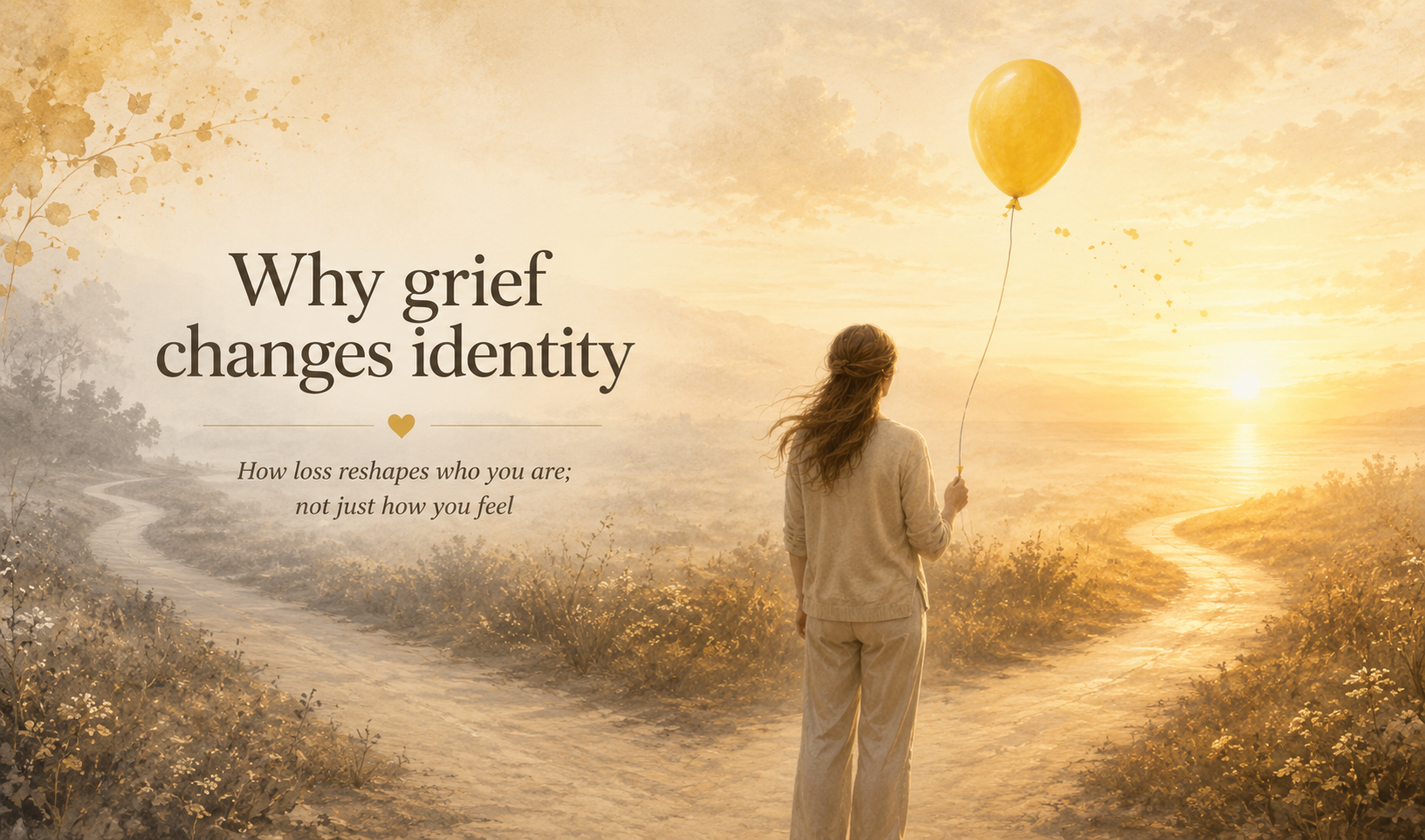
Grief doesn’t just make you sad.
It makes you unfamiliar to yourself.
People often talk about grief as pain, something you feel and eventually learn to carry. But grief is also a structural event, it rearranges the inside of you. It shifts the ground you stand on, and it quietly dismantles the version of yourself that existed before.
That’s why grief can feel so destabilising.
You don’t just miss someone.
You miss who you were when they were here.
The person you were made sense in a world that no longer exists
Before loss, your identity was threaded through everyday certainties you didn’t know you were relying on.
Who you were to them.
Who they were to you.
The future you assumed you were moving toward.
Loss doesn’t just remove a person.
It removes context.
Suddenly, the roles that shaped you: parent, partner, child, sibling, witness; feel unfinished, unresolved still alive inside you with nowhere to land.
You wake up still shaped by love, responsibility, history; but the world no longer mirrors that back.
That’s not confusion.
That’s rupture.
Grief fractures the story you were living inside
We all carry an internal narrative - a sense of this is my life, this is where it’s going.
Grief interrupts that narrative mid-sentence.
The future you expected becomes unreachable.
The past feels unbearably close.
The present feels thin, unreal, or suspended.
You may find yourself asking questions that feel almost dangerous in their honesty:
Who am I now?
What matters anymore?
How do I live in a world that allowed this?
These aren’t philosophical questions.
They’re identity tremors.
Why this disorientation hurts so much
Identity gives us coherence. It helps us feel continuous, like we are the same person across time.
Grief breaks that continuity.
You may feel:
older than your years, and suddenly very young
less ambitious, less interested, less certain
out of sync with people who seem untouched by loss
resistant to returning to who you were “before”
And then guilty for all of it.
But identity confusion isn’t a sign you’re failing to cope.
It’s a sign that the old shape of your life can no longer hold what you know now.
Grief doesn’t hollow you out - it exposes you
Many people worry that grief has ruined them.
That they are darker now.
Heavier.
Less optimistic.
Less easy to be around.
But grief doesn’t erase who you are.
It strips away what was superficial.
It exposes tenderness you didn’t know you had.
Anger you weren’t allowed to feel.
Clarity you can’t unsee.
Love that no longer has a place to go.
You are not becoming someone worse.
You are becoming someone who has been changed by depth.
There is no “return” - only integration
You won’t go back to who you were before.
But you also don’t need to reinvent yourself or find a new identity to justify surviving.
For most people, identity after grief doesn’t arrive fully formed. It emerges in fragments, it grows around memory, absence, and love that continues despite everything.
You may recognise yourself again - in flashes.
You may grieve the old version of you alongside everything else.
You may feel suspended between who you were and who you’re becoming.
That limbo is not a problem to solve.
It’s a passage.
A quieter truth
If you feel disoriented, uncertain, or unrecognisable to yourself, it doesn’t mean you’re lost.
It means you loved in a way that changed the structure of your life.
Grief doesn’t destroy identity.
It loosens it - so it can eventually re-form around a truth that includes loss.
And that takes time.