
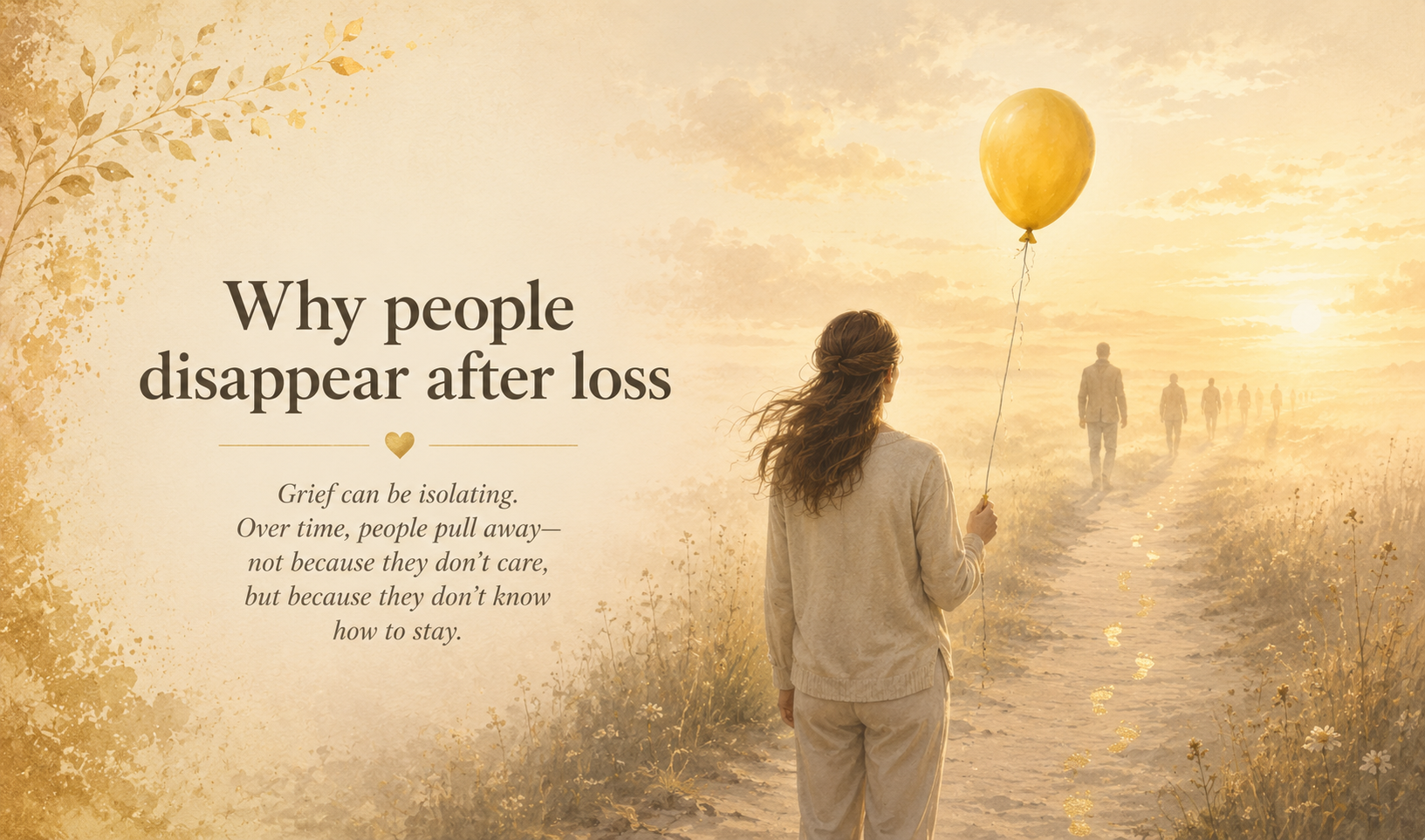
One of the most shocking parts of grief isn’t the loss itself.
It’s who vanishes afterward.
People you thought would stay close go silent.
Messages trail off.
Invitations stop coming.
Support promised in the early days quietly evaporates.
And you’re left grieving not just the person who died; but the relationships you thought would hold you.
This secondary loss is rarely talked about.
But for many people, it cuts just as deeply.
Grief makes other people uncomfortable, because they don’t know how to stay
Most people have very little experience with deep loss.
They don’t know what to say.
They don’t know how long grief lasts.
They don’t know how to be present without fixing.
So they retreat.
Not always out of cruelty - often out of fear.
Fear of saying the wrong thing.
Fear of reminding you of your pain.
Fear of their own vulnerability if they get too close.
Your grief confronts them with truths they’d rather avoid:
that love doesn’t guarantee safety,
that life can change without warning,
that there are losses you don’t “get over”.
And many people simply don’t have the capacity to sit with that.
Silence is often easier than witnessing pain
Grief asks something of people.
It asks them to tolerate discomfort.
To stay when there’s nothing to fix.
To listen without trying to make things better.
That kind of presence is rare.
So instead, people offer distance.
They tell themselves they’re giving you space.
They wait for you to “feel better”.
They assume you’ll reach out if you need something.
Meanwhile, you are carrying something enormous - and noticing who isn’t there to help hold it.
Time widens the gap
In the early days, support often arrives in bursts.
Meals.
Messages.
Offers of help.
Then time passes.
The world moves on.
Your grief doesn’t.
And the longer it lasts, the more uncomfortable it becomes for others. Grief that doesn’t resolve neatly disrupts the social expectation that pain should be temporary.
People don’t know where to place you anymore.
So they drift.
Not because your loss matters less, but because they don’t know how to live alongside it.
This absence can feel like rejection
When people disappear, it’s easy to internalise the loss.
You might wonder:
Am I too much now?
Did I say something wrong?
Should I be coping better by now?
But this distancing is rarely about your worth.
It’s about the limits of other people’s emotional capacity.
Grief doesn’t reveal who is good or bad.
It reveals who can tolerate depth.
The quiet truth
Some people can only walk with you until the path gets hard.
Others don’t know how to walk without maps, timelines, or reassurance.
A smaller group will stay; awkward, unsure, imperfect - but present.
Those people are gold.
Not because they say the right things.
But because they don’t leave.
A difficult realisation
Grief changes relationships.
Some will fade.
Some will fracture.
A few will deepen in ways you couldn’t have predicted.
This isn’t a failure of connection.
It’s a sorting.
Painful.
Unfair.
Often lonely.
But also clarifying.
If this has happened to you
If people have disappeared after your loss, it doesn’t mean you are unlovable.
It means you are living with something that many people don’t know how to face.
You didn’t become harder to care about.
The truth simply became harder to carry.
And that says far more about the limits of empathy than it does about you.